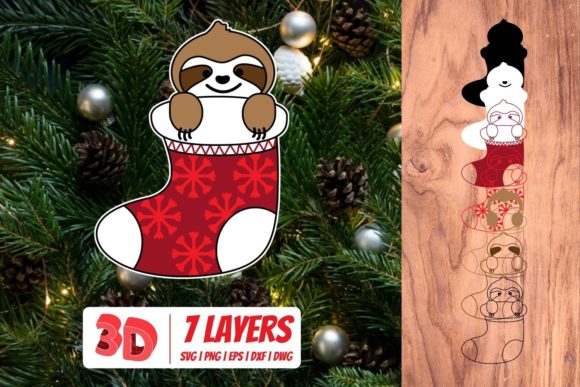
3D Christmas Sloth: A Designer's Review for Graphics and Crafts
I recently received a brief from a client launching a boutique holiday collection of handmade toys and seasonal greeting cards. They wanted something that felt cozy, whimsical, and distinctly modern, but without the generic, overused Santa or reindeer imagery that floods every craft store. The goal was to create a brand identity that stood out on social media while remaining versatile enough for physical merchandise like mugs and tote bags. That is when I discovered 3D Christmas Sloth, a graphic asset that immediately caught my eye as a potential hero element for their campaign.
As a professional designer who works with branding, packaging, and digital marketing visuals daily, I approach every new design asset with a critical eye. It is not enough for an image to simply look cute; it must function within a complex layout, maintain integrity across various file formats, and convey the right emotional tone. My first impression of this 3D Christmas Sloth illustration was one of immediate warmth. The rendering style creates a soft, tactile feel that suggests high-quality craftsmanship, which aligns perfectly with the "handmade business" aesthetic my client desired. It feels less like a flat clipart and more like a miniature sculpture, adding depth and visual interest to any composition.
Evaluating Visual Mood and Brand Fit
The visual mood of 3D Christmas Sloth is undeniably festive yet relaxed. In the world of modern design, there is often a tension between creating something strictly professional and allowing room for playfulness. This asset strikes a delicate balance. It represents a style that is perfect for small business branding targeting families, children, or those who appreciate artisanal goods. The character exudes a sense of calm and joy, making it an ideal choice for marketing visuals intended to slow down the consumer and invite them into a story.
For a project involving packaging design or product mockups, this illustration offers a strong focal point. When placed against a clean background, it commands attention without shouting. However, if the goal were a corporate financial report or a strict legal document, this asset would be entirely inappropriate. It belongs in contexts where emotional appeal and audience engagement are prioritized over rigid formality. It fits naturally into editorial design for lifestyle magazines, web design for boutique shops, and social media graphics for platforms like Instagram and Pinterest where visual storytelling is key.
Technical Performance Across Formats
One of the most critical aspects of any graphic design asset is its versatility. For this review, I examined the contents of the download package. The fact that the Download includes svg, dxf, png and eps formats in a zipped folder is a massive advantage for a working designer. Each format serves a specific purpose in the production pipeline, ensuring the asset can be adapted for both digital screens and physical printing.
The inclusion of vector files is particularly noteworthy. SVG can be used with Cricut Design Space, and Silhouette Designer Edition, Make the Cut MTC , Sure Cuts A Lot SCAL , and Brother Sca. This compatibility means the asset is ready for Cricut projects and sticker design workflows right out of the box. As a designer, I value this because it allows for seamless scaling. Whether I am creating a large banner for a local event or a tiny logo for a t-shirt design, the vector data ensures crisp edges at any size. The EPS and DXF files are essential for sublimation design and industrial cutting machines, providing the precision needed for high-volume print-on-demand operations.
The PNG file adds another layer of utility. With transparency preserved, it can be layered over textured backgrounds, such as kraft paper or fabric patterns, without looking jarring. This is vital for creating realistic product mockups where the design needs to sit naturally on a surface. For Canva templates or quick digital ads, the raster version provides immediate usability without needing to open specialized software.
Strategic Placement and Hierarchy
In terms of visual hierarchy, 3D Christmas Sloth performs best as a primary subject or a significant decorative accent. I recommend placing it in large layout areas, such as a hero graphic on a landing page or the central focus of a holiday flyer. Its three-dimensional quality gives it weight, making it suitable for anchoring a composition. When used as part of a themed collection, it can serve as a recurring motif that builds brand recognition.
However, designers must exercise caution. This asset should be used carefully in small sizes or crowded layouts. If scaled down too much for a favicon or a tiny icon, the 3D details may blur, losing the charm that makes it effective. Similarly, in minimalist branding where clean lines and negative space are paramount, the complexity of the sloth might clash with the intended aesthetic. It is also important to consider contrast; on low-contrast designs or busy backgrounds, the figure might get lost. For professional corporate materials requiring a very strict visual hierarchy, this playful character might undermine the authority of the message.
Practical Designer Notes for Commercial Use
Before integrating 3D Christmas Sloth into a real client project, there are several technical checks every designer should perform. First, always test the asset in black and white. This helps ensure that the shape and form remain distinct even when color is removed, which is crucial for print processes that rely on single-color ink. Second, preview the design at both small and large sizes to verify that no pixelation occurs in the raster versions or that the vector paths do not become too intricate for the intended medium.
Inspecting the file quality is non-negotiable. Check the PNG transparency to ensure there are no jagged white halos around the edges. If using the SVG, inspect the vector editability to see if you can easily adjust colors to match a client's specific brand palette. Compare the illustration with your chosen typography. Does the whimsical nature of the sloth pair well with a serif font, sans serif font, script font, handwritten font, or display font? Often, a bold display font complements the 3D style better than a delicate script, depending on the overall vibe.
Furthermore, place the design on real mockups before finalizing the concept. Seeing how the 3D Christmas Sloth looks on a ceramic mug versus a paper bag can reveal issues with scale and perspective that are hard to spot on a screen. Finally, confirm the commercial license. Since this is for a client project, you must ensure that the commercial license covers the specific use cases, such as resale items or unlimited print runs. Never assume a standard license covers all design assets intended for profit.
Final Verdict on Creative Potential
3D Christmas Sloth is more than just a festive clipart; it is a robust creative design tool that bridges the gap between digital art and physical production. Its ability to transition smoothly from a logo design element to a full-page illustration makes it a valuable addition to any design bundle or portfolio. For digital sellers, Etsy product creators, and content creators looking to elevate their holiday campaigns, this asset offers a unique blend of charm and technical flexibility.
When used with intention and respect for its visual properties, this illustration can significantly enhance the perceived value of a project. It transforms a standard holiday card into a memorable piece of art and turns a simple t-shirt into a statement of style. For any designer seeking to add a touch of whimsy and professionalism to their crafts and graphics work, this is a highly recommended resource.